
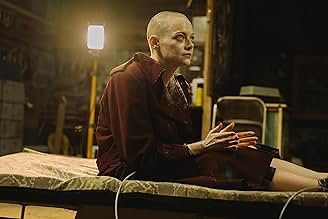
“Bugonia” directed by Yorgos Lanthimos, ends on a note that is both apocalyptic and strangely intimate. Humanity is wiped out in an instant. Meanwhile, a handful of bees quietly return to their hive. This contrast is crucial for understanding the film’s ending. It explains its deeper logic from the perspectives of screenwriting, directing, performance, and production.
The cast includes Emma Stone, Jesse Plemons, Aidan Delbis.
The ending, step by step
In the final act, Teddy forces Michelle, the CEO of Auxolith, back to her office at gunpoint and strapped to a bomb vest, convinced that there is a secret Andromedan portal hidden there. She plays along, guiding him toward a wardrobe that she presents as a teleportation device.
Teddy steps inside, expecting to be transported to the alien mothership and finally prove he was right. Instead, the bomb detonates, killing him and severely injuring Michelle.
Michelle wakes up in an ambulance during the lunar eclipse that Teddy had always seen as the moment of alien intervention. She escapes and returns to the Auxolith office. She steps into the same wardrobe, this time actually using it as a portal.
On the Andromedan ship, the film finally confirms what Teddy had believed all along: Michelle is the Empress of Andromeda. In council with her advisors, she judges the human experiment a failure and decides to end it decisively.
She punctures a bubble covering the top half of a flat model of Earth, and humanity dies instantly. The movie closes on the now empty world, while the bees slowly return to Teddy’s hive, suggesting that the planet will go on without us.


Screenwriting logic: conspiracy, truth and the “wrong hero”
From a screenwriter’s point of view, the ending pays off a central irony. The conspiracy theorist is right about the existence of aliens and their interference. However, he is wrong about almost everything else that matters. This is a classic “wrong hero, right world” construction. The protagonist’s beliefs accidentally line up with reality. However, his motivations and methods are fundamentally broken.
The script seeds this twist carefully:
- Teddy’s obsession with Andromedians and bees.
- The eclipse deadline that structures the entire story.
- The backstory of his mother Sandy as an experimental subject for Auxolith’s drug.
These elements build a paranoid thriller structure. The ending then flips genre expectations. It reveals that Teddy’s paranoia has been aimed in the right direction. However, his paranoia is weaponised by trauma instead of revealing that Teddy was delusional.
Crucially, the final choice belongs not to Teddy but to Michelle. That shift of agency turns the ending from a personal revenge story into a cosmic evaluation of humanity. The screenwriting design here follows a Lanthimos pattern: a protagonist destabilises the world, but a different character takes the truly decisive action in the climax.


Directing perspective: tone, staging and moral distance
Directorially, the ending is staged to keep the audience in an uncomfortable space between absurdity and dread. The bomb vest in a bland corporate office feels slightly ridiculous and terrifying at the same time. The banal wardrobe as a cosmic portal is equally absurd and frightening. Additionally, the flat model of Earth on the alien ship conveys these contradicting emotions.
This tonal balance does three things:
- It preserves a satirical distance from the apocalypse, making the annihilation feel like a bureaucratic procedure rather than a spectacle.
- It avoids the usual disaster-movie language, which would invite empathy on a grand scale; instead, we watch a clinical decision.
- It keeps us focused on Michelle’s body language and micro-choices rather than on special effects.
The final shots of the bees returning to the hive are directed almost as a nature documentary. This stylistic choice underlines the idea that the film is less about the end of the world and more about the end of humans as a failed evolutionary experiment.
Performance and character work: Michelle, Teddy and Don
From an acting perspective, the ending highlights the work done on three key characters. These characters are Teddy, Michelle, and Don.
Teddy arrives at the finale already broken by grief, guilt and humiliation. His threat is real, but his emotional core is that of a son who cannot accept that the system hurt his mother and never paid for it. When he steps into the wardrobe, he is at once a terrorist and a believer walking into his own church.
Michelle navigates a much more complex spectrum. For most of the film, she is the trapped executive fighting to survive a kidnapping. Her choices in the ending—first manipulating Teddy toward his death, then calmly returning to the portal and accepting her role as Empress—reveal a double identity that had always been there under the surface: efficient CEO on Earth, cold ruler off Earth.
Don, the neurodivergent cousin, never reaches the ending, but his suicide shapes it. His inability to bear the pressure of Teddy’s worldview and Michelle’s pleas foreshadows the larger “collapse under pressure” that humanity will face in the last scene.
Thematic analysis: experiment, ethics and the value of humanity
Thematically, the ending reframes everything we have seen as part of a much larger experiment. The film suggests that humans were created by Andromedians as a kind of second attempt after the accidental destruction of the dinosaurs.
Sandy’s suffering becomes one of many trials designed to push humans toward a “next evolutionary phase” of empathy and harmony. Instead, the experiment produces corporate cover‑ups, conspiracy violence and personal revenge.
Michelle’s decision to end humanity is not portrayed as evil in an operatic sense, but as a utilitarian managerial call: the project has failed, resources will be reallocated. This is where the film is at its most chilling: our extinction is treated like closing an underperforming division in a company.
The bees, spared and shown returning home, embody the opposite of human chaos: a collective intelligence that does not wage war on itself or the planet. The implication is not that nature is “good” and humans are “bad”, but that, within the logic of the Andromedian experiment, humans did not meet the target metrics.
Production and distribution
“Bugonia” is an English-language remake of the South Korean film “Save the Green Planet!” directed by Jang Joon-hwan. Directed by Yorgos Lanthimos, it stars Emma Stone and Jesse Plemons and was shot between July and September 2024 in locations including Oxfordshire, Greece, New York and Georgia.
The film premiered in competition at the 82nd Venice International Film Festival on 28 August 2025 and was released in Italy on 23 October 2025, with a 24 October release in North America. Its festival positioning and global distribution support the film’s hybrid identity: an auteur vision packaged as genre entertainment.
why this ending will keep being discussed
As an ending-explained topic, “Bugonia” is inherently evergreen for several reasons.
- It blends conspiracy thriller, black comedy and sci‑fi allegory, inviting multiple re‑interpretations over time.
- Its core questions—are humans worth saving, is the system rigged, when does paranoia turn into prophecy—are not tied to a specific year or event.
- The final twist about Michelle’s identity and the flat Earth model rewards rewatching and ongoing debate.
From a filmmaker’s standpoint, this is an ending you can return to when teaching structure, character and theme working together. It shows how a story can honour genre expectations (the twist, the reveal, the explosion) while radically shifting the moral and philosophical stakes in the last few minutes.
Awards note
“Bugonia” is nominated at the 2026 Oscars. It received a nomination for Best Picture. There are also nominations for Emma Stone as Best Actress, Will Tracy’s adapted screenplay, and Jerskin Fendrix’s original score.
If you are a filmmaker or just an aspiring one, you can learn filmmaking by purchasing this book. Get it from our shop , Amazon or Barnes & Noble.

This article contains affiliate links. If you click and make a purchase, we may receive a commission. This is at no additional cost to you. Thank you for your support!
🎥 Follow The Hidden Review!
Stay ahead with the latest news, reviews, and interviews. Gain tips from our Blog and exclusive insights. Get behind-the-scenes updates on movies, TV shows, and more!
📌 Don’t miss out—hit that subscribe button and tap the bell for notifications. 🔔
🔍 Stay in the know with The Hidden Review:
✨ Discover what’s hidden, only with The Hidden Review.
©2026 The Hidden Review