
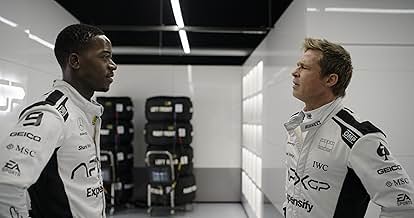
F1 directed by Joseph Kosinski ends without a simple victory lap. Instead, it concludes with a layered, bittersweet resolution. This resolution fuses racing spectacle with character growth, legacy, and the cost of obsession. The final race in Abu Dhabi presents Sonny Hayes’ long-delayed dream. However, it also closes his arc. The end feels more like a farewell than a triumphant beginning.
The cast includes Brad Pitt, Damson Idris, Javier Bardem, Kerry Condon.

The Final Race: What Actually Happens
In the climactic Abu Dhabi Grand Prix, the APXGP team arrives under pressure. Financial survival depends on this race. Reputational damage and internal fractures also converge on a single race. Sonny Hayes, an aging former prodigy, has been brought back from the margins of motorsport. He returns to the cockpit after injury and dismissal. He pushes through physical and psychological limits to compete one last time.
On track, APXGP’s two drivers, Sonny and the young talent Joshua Pearce, finally operate as a cohesive unit. They use strategy and racecraft to fight established stars in faster cars. Late in the race, chaos erupts: Joshua and Lewis Hamilton collide, removing the main contenders in front of Sonny. Sonny capitalizes on the opening. He crosses the finish line first. This secures both his first Formula One victory and the salvation of the APXGP team’s future.
However, the celebrations are not simple. Joshua’s career prospects, the team’s ownership issues, and Sonny’s physical condition hang over the podium. The ending deliberately juxtaposes the roar of the crowd with quiet moments. Sonny prepares to step away. His win is both a crowning achievement and a farewell gesture.

Screenwriting Perspective: Structure, Payoff, and Theme
From a screenwriting standpoint, the ending provides a classical payoff to a sports drama set-up. It includes a modern twist in tone and character focus.
- Delayed gratification: Sonny’s backstory of a career-ending crash decades earlier plants a goal he never reached—winning a Formula One race. The script pays this off in the final laps, giving him the victory he was denied in his prime.
- Dual-protagonist tension: The narrative balances two arcs—Sonny’s redemption and Joshua’s rise. Choosing to let Sonny win the final race shifts the film from a pure “passing the torch” story into a meditation on unfinished business and the weight of history.
- Ethical ambiguity: Throughout the film, Sonny’s aggressive strategies border on reckless, putting Joshua at risk and provoking controversy. In the end, his win comes after a crash that removes Joshua and Hamilton. This leaves the audience to debate how much of that outcome is tactical brilliance. They also consider how much is chaos and luck.
What makes the ending evergreen is that it invites multiple readings: is Sonny a hero finally recognized, or an old racer who stole the spotlight from the future for one last hit of glory? The script refuses to answer definitively, and that ambiguity keeps the conversation alive.


Directing Choices: Speed, Space, and Emotional Focus
From a directing perspective, the ending is a masterclass in balancing kinetic energy with emotional clarity.
- Race geography: The director carefully establishes the track layout. They highlight key overtaking zones and the relative positions of the main cars. This ensures the final laps are easy to follow even for non‑F1 fans. This clarity makes Sonny’s eventual pass and the crash sequence feel earned rather than arbitrary chaos.
- Subjective tension: Camera placement and sound design frequently leave the “TV broadcast” perspective. They dive into Sonny’s cockpit—engine noise muffled, breathing loud, focus narrowed. This reminds us that this is not just a race but a trauma confrontation. Every close call echoes his earlier crash.
- Restraint in victory: The final podium and celebration scenes avoid overblown melodrama. Instead of a long speech or a montage of press headlines, we get human-scale beats: embraces, glances, the way Sonny looks at the trophy as if weighing what it cost him.
These directorial choices ensure the ending feels grounded rather than cartoonish, which is crucial for an evergreen film analysis. Viewers can return to the sequence and discover new details in blocking, framing, and performance every time.
Producing Angle: Franchise Positioning and Audience Appeal
Looking at the ending as a producer, it serves several strategic purposes.
- Four-quadrant appeal: The final race delivers high-stakes action for casual viewers while rewarding racing fans with a credible depiction of strategy, tire management, and race rules. This balance is essential for sustained streaming and rewatch value.
- Sequel potential: Leaving Joshua’s future open, and showing Sonny quietly preparing to leave rather than definitively retiring on-screen, gives the franchise room to continue. Future installments could focus on Joshua’s next step, a new generation of drivers, or even Sonny in a management or mentoring role.
- Brand synergy: Incorporating real teams and drivers like Lewis Hamilton strengthens authenticity and marketing synergy. The ending leverages this by making the final duel partially against real-world legends, embedding the fictional story into the broader F1 mythos.
From a lifecycle point of view, this ending is built not just to close a story, but to keep the film relevant in discussions around F1 seasons, Oscar cycles, and sports narratives for years.
Acting and Character Work in the Final Act
The emotional impact of the ending depends heavily on performance choices.

Sonny Hayes
As a character, Sonny is defined by contradictions: charismatic yet self-destructive, brilliant yet impulsive, protective yet dangerous. In the final race, the actor’s work shows:
- The physical cost of each corner and braking point, reminding us he is not a twenty‑year‑old phenom but a body carrying old damage.
- Small, quiet beats—hesitations on the radio, glances at Joshua’s car—where we see him weighing whether to prioritize team strategy or personal redemption.
- On the podium, a restrained joy, as if he knows this is not the beginning of a new career but the closure of an old wound.
Joshua Pearce
Joshua’s arc peaks and crashes in the climax—literally and figuratively. His collision with Hamilton removes him from the fight just when he seemed poised to inherit the team’s legacy. As a performance, it’s important that:
- He doesn’t become a simple victim; his earlier stubbornness and desire to prove himself made the partnership with Sonny fragile.
- His reaction to the outcome—disappointment mixed with respect for Sonny—keeps the relationship complex and avoids a simplistic rivalry.
Their dynamic gives the ending emotional depth beyond the checkered flag.
Distribution and Audience Reception Layer
The film’s ending is designed to play differently across platforms and over time.
- Theatrical impact: On a big screen, the sound and speed of the final laps are overwhelming, creating a shared adrenaline rush that makes Sonny’s win feel cathartic.
- Streaming rewatchability: On repeat viewings at home, subtler elements stand out: the editing rhythm, radio calls, and foreshadowing in earlier races. This deepens appreciation and keeps “ending explained” discussions evergreen.
- Global resonance: Motorsport is global, and the film’s final race in a high-profile circuit like Abu Dhabi taps into a real-world tradition that recurs every year. Each new F1 season gives audiences a reason to revisit the movie and its finale.
For distributors and platforms, an ending that keeps generating think pieces, breakdown videos, and fan debates is an asset that extends the film’s lifespan well beyond its initial release window.
Thematic Core: Legacy, Risk, and Knowing When to Let Go
Thematically, the ending isn’t just about who wins. It’s about what victory means when it comes at the end of a career defined by risk.
- Legacy over statistics: Sonny’s single win late in life carries more emotional weight than a whole list of podiums might have earlier. It’s a statement about finishing your story on your own terms, even if you arrive late.
- Risk and responsibility: The film never fully absolves Sonny for the danger he creates. The injuries, crashes, and team turmoil all sit in the background as he lifts the trophy. The ending asks whether greatness in such a dangerous sport can ever be ethically clean.
- Letting go: Sonny’s quiet exit hints that true maturity is knowing when to stop chasing speed and start valuing the people and future you might leave behind.
These themes keep the ending relevant beyond motorsport fans, touching anyone who has wrestled with ambition, aging, and the fear of leaving things unfinished.
Awards
Within the film’s world and real-world reception, F1 has crossed over from genre entertainment into awards conversation. It is nominated for the 2026 Oscars which will be held on March 15, 2026 at The Dolby Theatre in Los Angeles. This includes key categories such as Best Picture. It also involves recognition for its performances and technical craft.
If you are a filmmaker or just an aspiring one, you can learn filmmaking by purchasing this book. Get it from our shop , Amazon or Barnes & Noble.

This article contains affiliate links. If you click and make a purchase, we may receive a commission. This is at no additional cost to you. Thank you for your support!
✨ Discover what’s hidden, only with The Hidden Review.
©2026 The Hidden Review