
Animated family films rarely get to have it both ways: broad enough for children, sharp enough for adults, and emotionally coherent enough to feel like more than an assembly of recycled gags and franchise-safe lessons. Spies in Disguise comes closer than most. It packages espionage spectacle, buddy-comedy friction, and a surprisingly earnest meditation on nonviolence into a streamlined studio feature that knows exactly how to keep moving. It is not revolutionary, but it is unusually nimble — and, at its best, disarmingly sincere.
What makes the film distinctive is not simply its premise, though turning a suave super-spy into a pigeon is the sort of high-concept comic reversal animation is built to exploit. It is the way that reversal becomes the film’s governing idea. Spies in Disguise is less interested in proving that spy fiction can be made safe for children than in asking what happens when competence, ego, and brute force are stripped away in favor of improvisation, empathy, and collaboration.
A classic spy fantasy, gently revised
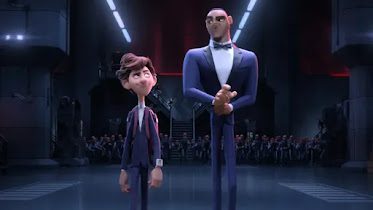
At the center is Lance Sterling, voiced by Will Smith with a coolly calibrated blend of charisma and self-regard. Lance is the kind of secret agent animated films love to celebrate: polished, untouchable, effortlessly authoritative. The film introduces him as a man who has spent so long embodying the fantasy of controlled masculinity that the loss of control becomes the real narrative engine. When a mission goes sideways and he is transformed into a pigeon, the film does not just harvest easy visual comedy. It dismantles the character’s professional mythology.
That choice gives the movie an unexpectedly smart structure. Lance’s transformation is funny, yes, but it is also thematically efficient. The film uses absurdity to puncture arrogance, and it does so without turning its lead into a simple punchline. That balance matters. The joke is never just that the spy is now a bird. The joke is that the spy’s old methods no longer work.
Tom Holland gives the film its conscience
If Smith provides the swagger, Tom Holland supplies the emotional counterweight. As Walter Beckett, the brilliant but socially awkward inventor behind the film’s more humane technology, Holland leans into a gentler register that makes the character feel both comic and credible. Walter is the sort of animated supporting figure who could easily be reduced to “quirky genius” shorthand, but the film gives him enough vulnerability and conviction to register as more than a device.
Crucially, the relationship between Lance and Walter is not built on simple opposition for the sake of banter. It is built on mutual correction. One man has speed but little patience for nuance; the other has ideas but lacks the confidence to impose them. Their partnership works because each is forced to acknowledge a blind spot in the other. That is a more durable foundation than the usual “odd couple” formula, and the film benefits from it.
Animation with polish and purpose
Visually, Spies in Disguise is one of those studio animated films that understands the value of surface pleasure. The colors are crisp, the movement is fluid, and the action scenes are designed with a clarity that prevents chaos from becoming visual fatigue. The film’s polished look is not merely decorative. It supports the genre hybrid the story is trying to build, allowing fast-paced espionage sequences to coexist with comic exaggeration and emotional beats.
The character animation deserves particular mention because it does a lot of the storytelling work. Facial reactions, physical timing, and the contrast between Lance’s sleek composure and Walter’s awkward energy are all rendered with enough precision to make the relationship feel alive. In a film like this, expression is not a secondary concern; it is the mechanism through which the emotional stakes stay legible.
The film’s real subject: trust
Beneath the comic premise and the kinetic pacing, Spies in Disguise is really about trust — who earns it, who withholds it, and what happens when institutions built on secrecy begin to look brittle. The film’s fictional agency, with its acronym-heavy nobility, is the sort of bureaucratic fantasy that spy stories often deploy as a shorthand for legitimacy. But the movie is more interested in whether the system’s confidence is justified, and whether heroism is better measured through force or through judgment.
That gives the film an unusually clear moral shape for a family adventure. It argues, in accessible terms, that intelligence without empathy is incomplete, and that violence is not the only language of competence. The pigeon conceit is more than a gag: it is a metaphor for humility, adaptability, and the willingness to accept forms of action that are not traditionally associated with power.
A family film with a real point of view
What keeps Spies in Disguise from becoming overly didactic is its tonal ease. It understands that a moral lesson lands best when it is embedded inside momentum, humor, and character chemistry. The film never pauses to announce its values in heavy-handed terms. Instead, it lets its plot demonstrate them. That is a notable strength, especially in a genre where sentiment often arrives wrapped in slogans rather than dramatic logic.
The film also benefits from being accessible without feeling condescending. Children get the transformation comedy, the sleek action, and the energetic world-building. Adults get the sly genre play, the voice cast chemistry, and the more pointed suggestion that modern heroism may require less swagger than self-awareness. That dual address is one of the reasons the film travels better than many similarly pitched studio animations.
Verdict
Spies in Disguise succeeds because it knows how to use a ridiculous premise as a framework for something more thoughtful. It is funny without becoming chaotic, stylish without becoming hollow, and warm without collapsing into sentimentality. Smith and Holland make an effective pair, the animation is polished and expressive, and the film’s core idea — that trust and cooperation matter more than domination — is handled with enough intelligence to feel genuinely earned.
It may not reinvent the animated spy movie, but it does something arguably more difficult: it makes the familiar feel slightly revised, and the absurd feel emotionally useful. That is enough to make it a sharp, crowd-pleasing entry in the family-action lane, and one that understands the value of being clever without losing heart.
Hidden Fire stars 9/10
Spies in Disguise is now available on Disney Plus, Netflix, Prime Video. Furthermore, it is also available in Blu-Ray on Amazon.
Whether you are a filmmaker or just an aspiring one, you can learn filmmaking by simply purchasing this book from either Amazon or Barnes & Noble.

This article contains affiliate links: if you click and make a purchase, we may receive a commission at no additional cost to you. Thank you for your support!
️🎥 Follow The Hidden Review!
Stay ahead with the latest news, reviews, interviews, tips from our Blog, exclusive insights, and behind-the-scenes updates on movies, TV shows, and more!
📌 Don’t miss out—hit that subscribe button and tap the bell for notifications. 🔔
🔍 Stay in the know with The Hidden Review:
✨ Discover what’s hidden, only with The Hidden Review.
©2020 The Hidden Review
Leave a Reply