
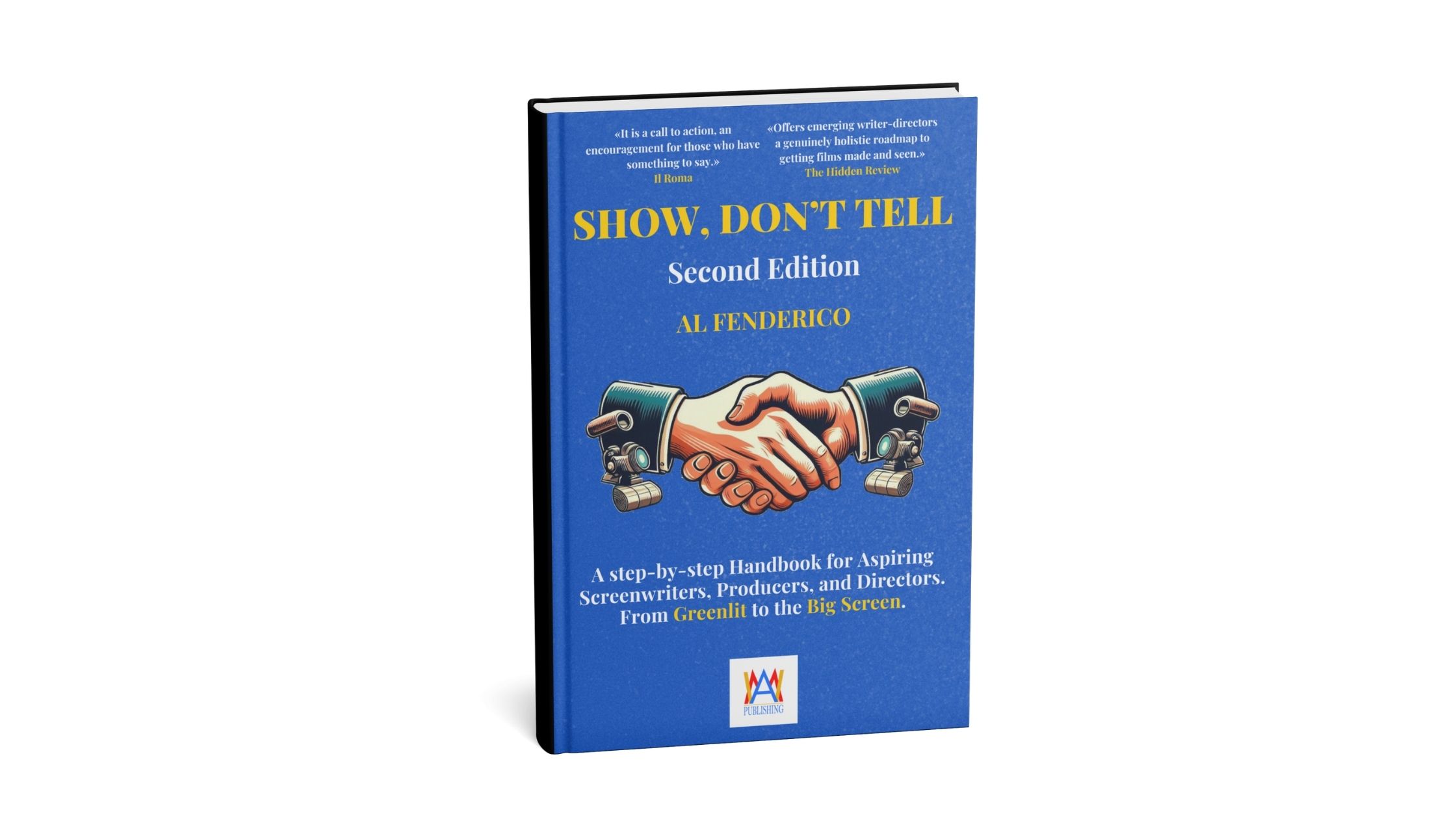
“Show, Don’t Tell” by AL FENDERICO is a dense, practice‑oriented handbook that maps the full journey from the blank page to distribution, treating screenwriting, producing and directing as a single, integrated craft rather than separate silos. It reads less like a motivational pamphlet and more like a pragmatic production manual aimed squarely at aspiring filmmakers working between Europe and the Anglo‑American industry.
Scope and structure
The book is explicitly designed as a “step‑by‑step handbook for aspiring screenwriters, producers, and directors”, and its architecture reflects this ambition. After a reflective preface that situates the author’s trajectory from actor to award-winning filmmaker trained at the Royal Central School of Speech and Drama, he has won many awards throughout his career.
Moreover, he has been awarded lately the Vincenzo Crocitti Award as an emergent director, actor, and screenwriter; moreover, he has received multiple accolades for his first international feature film screenplay, Belong, internationally from the Italian, UK, US, and Canadian film markets, which he just announced a few weeks ago will become a novel called “Belong: A Soul’s Diary“ – a YA adult novel genre which is already receiving multiple requests worldwide.
Furthermore, for his TV series “Legends: Giving It All” in Los Angeles and from the Canadian film market.
This second edition volume moves even deeper through screenwriting fundamentals, formatting, story development, industry practice, budgeting, finance, pitching, casting, distribution, crew hiring, legal frameworks and a closing reflection.

A detailed table of contents reveals a pedagogical progression: early chapters establish what a screenplay is, how to draft and revise it, and how industry-standard formatting functions; later chapters handle budgeting top sheets, line-item breakdowns, finance plans, pitch decks, casting protocols, distribution windows and crew structures in US/UK and broader international contexts. This progression makes the book unusually comprehensive for a single volume, effectively positioning it as an entry‑level producing textbook as much as a writing guide.
Theoretical stance: “Show, don’t tell” as epistemology
Fenderico does not treat “Show, Don’t Tell” as a clichéd note but as a core epistemological stance: stories should be enacted through behaviour, image and sound rather than explained through commentary.
The opening chapters articulate the maxim in relation to both prose origins and cinematic language, emphasising that the goal is not to banish exposition entirely but to prioritise visual and auditory storytelling that allows the reader or viewer to infer emotion and conflict.
This theoretical baseline is consistently reinforced by concrete examples in the formatting chapter—scene headings, action lines, dialogue and parentheticals are all discussed in terms of what the audience can see and hear, with explicit warnings against flattening drama into external explanation. The result is a coherent bridge between theory and practice: the mantra is not merely quoted; it is operationalised into line‑level craft advice.
Pedagogical clarity and practical tools
On the page, the book adopts a clear, didactic tone that resembles a university‑level handbook more than a conversational blog, yet it remains accessible for non‑academic readers.
Core concepts—such as outlining, three‑act structure, character arcs, and the distinction between above‑the‑line and below‑the‑line costs—are broken into bullet‑point strategies and checklists designed to be actioned rather than admired.

At the same time, the chapter on budgeting and scheduling is particularly notable for its inclusion of a fully worked budget template, from topsheet to detailed line items, using standard categories familiar from US/UK production environments and specialist software (discover more in the book).
In fact, likewise sections on industry resources and software provide concrete references following industry standards, positioning the handbook as a gateway to a wider ecosystem rather than a closed system.
Industry literacy and territorial specificity
One of the book’s strengths is its consistent attention to specific industrial contexts in the US, UK, Canada and, to a lesser extent, Italy. Chapters on industry insights, film finance and distribution do not limit themselves to generic advice; they reference guild structures (discover more in the book), public funding bodies (discover more in the book), tax‑incentive regimes, and key markets and festivals (discover more in the book).
The distribution chapter, framed explicitly around what “actually works in 2026” in the US, Canada and UK, offers a sober breakdown of theatrical, streaming, AVOD/FAST, TV licensing, physical media and educational markets, including realistic notes on P&A costs, revenue splits and the narrowing role of physical formats. This industry literacy differentiates the book from many writing manuals that end at “fade out” and will be particularly valuable for emerging producers and writer‑directors seeking to understand how projects travel beyond development.
Balance of craft and business
However, a recurring theme is the insistence that craft and business cannot be separated: the same volume that explains inciting incidents and midpoints also teaches query etiquette, submission releases, rights assignments, recoupment logic and the dangers of signing overly broad option agreements.
The author repeatedly urges readers to consult specialised legal counsel or guild support before signing contracts, and he contextualises competition entries and discovers more in the book platforms and online exposure within realistic expectations rather than fantasy shortcuts.
Similarly, the chapters on film finance and pitch decks position creative materials—loglines, synopses, and visual mood boards—alongside business plans, finance puzzles and explicit recoupment waterfalls, treating the pitch as both aesthetic proposition and investment prospectus. For early‑career filmmakers who often master one side of this equation at the expense of the other, this integrated perspective is a substantive strength.
Ethics, inclusion and professional culture
Beyond technicalities, the book engages with contemporary concerns around ethics and inclusion in casting, working with minors, intimacy coordination, and safe-set practices, referencing best-practice guidelines from unions and professional associations. The emphasis on humility in the ‘reading and writing room’, on collaborative etiquette, and on health and safety reflects a production culture increasingly attentive to worker well‑being, not just output.

But the discussion about AI within distribution and marketing (particularly social media analytics and campaign optimisation) is cautious and pragmatic: AI is framed as a tool rather than a substitute for human creativity, with an explicit acknowledgement of unresolved ethical issues around AI‑generated imagery and voice.

Style, audience and limitations
Stylistically, the manual occupies a middle ground between academic formality and trade‑press pragmatism. Sentences are often long and syntactically rich, reflecting the author’s academic training, yet the structure—short sections, bullets, and examples—prevents the text from becoming opaque. Furthermore, for absolute beginners with no exposure to English‑language industry jargon, the density of terminology might initially feel demanding, but key terms are generally defined in context.
A natural limitation of any single‑author handbook is that it cannot cover every national context or niche practice. While the book engages meaningfully with US, UK, Canadian and some European frameworks, filmmakers working in radically different regulatory or industrial environments will need to adapt certain models, particularly in the areas of labour law, public funding and tax incentives. Nonetheless, the underlying principles—structured budgeting, transparent finance, and rights awareness—are broadly transferable.
‘Show, Don’t Tell’ is now available online on Amazon and Barnes & Noble as an ebook, paperback and hardcover.
✨ Discover what’s hidden, only with The Hidden Review.
©2026 The Hidden Review